
2026 trends: Crucial knowledge for nonprofit leadership success
Ellen Glasgow
December 31, 2025


With the first campaigns and initiatives of 2026 already underway, board members are looking ahead to a year promising big changes — and bigger opportunities for those prepared to seize them.
We’re kicking off the year with insights from leaders of mission-driven organizations around the world. Here’s what they’re pursuing, which strategies have found traction and where they see the most exciting sources of change plus the practical board actions that turn strategy into impact.
Read on for a glimpse into the year to come.
2026 trends for nonprofits
1. Advocacy (with a quick compliance refresher)
A tumultuous social, political and economic climate makes the work of mission-driven organizations more important than ever — even as it complicates how that work gets done.
Leaders ranked advocacy as their top governance concern for 2026. They’re grappling with how to advance their missions when federal funding mechanisms, key institutions and regulatory regimes are shifting fast. The other half of the challenge? Capacity. Retention and hiring remain tough, especially amid funding uncertainty and evolving rules around tax incentives and fundraising.
As Katharine Earhart, Partner and Co-Founder at Fairlight Advisors, notes, boards are also navigating greater structural and regulatory complexity alongside these pressures: “I think folks are discussing mergers and shared services more than previously in this current environment. I also think there is a need to understand the difference between advocacy and lobbying and what nonprofits can/cannot do.”
Board actions to stay effective — and compliant:
- Clarify roles: Distinguish board, leadership and staff responsibilities in advocacy efforts.
- Train on the line between advocacy and lobbying: Ensure directors and staff understand what nonprofits can and can’t do.
- Scenario-plan your priorities: Build durable policy priorities that can flex through funding shocks and regulatory swings.
Advocacy vs. lobbying basics for boards
- Provide a one‑page refresher at orientation and annually
- Designate a policy point person
- Document pre‑approved talking points and escalation paths
2. AI governance & ethics
Enter AI — the elephant in the room for both data management and workforce efficiency. Most nonprofits are already using AI tools for routine automation, communications and analysis; the 2026 priority is moving from ad‑hoc experimentation to organization‑wide policies and workflows that emphasize safety, quality and measurable gains.
That shift is already underway, according to Julie Castro Abrams, CEO of How Women Lead: “IT security and new uses for AI is still critical. The trend that’s coming is nonprofits moving from individual to strategic organizational use, including creating simple Acceptable AI Use policies to ensure responsible adoption.”
What good looks like in 2026:
- Approve a short, plain‑language Acceptable AI Use policy aligned to your data privacy obligations and community expectations.
- Roll out in stages: Start with secure, fit‑for‑purpose admin and content workflows; then scale to analytics and service improvements.
- Choose partners who offer strong encryption, data ring‑fencing and nonprofit‑ready workflows.
GovernAI for BoardEffect
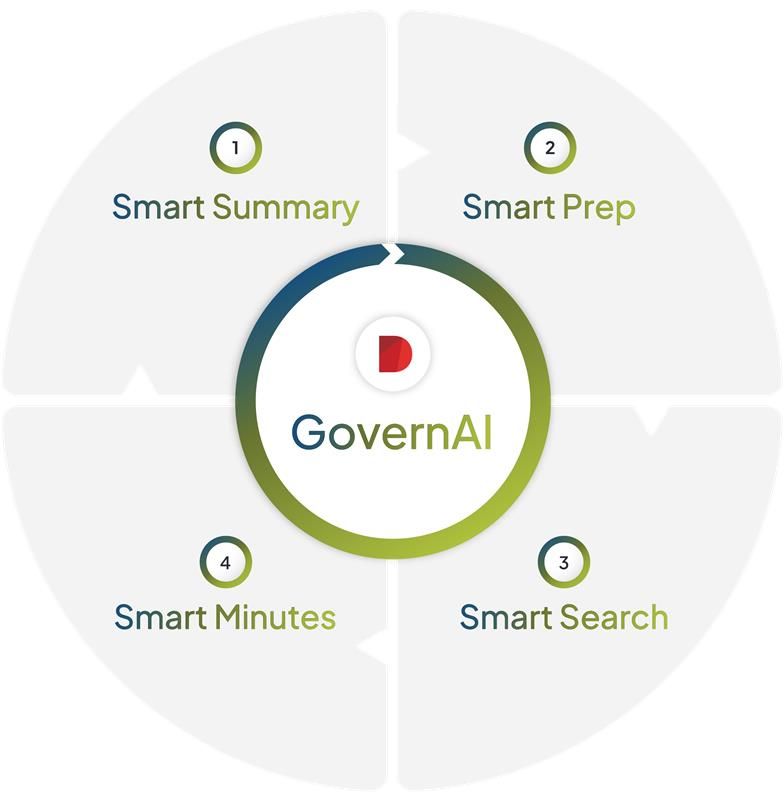
We’re always looking for ways to make BoardEffect more useful and more productive for nonprofits. Our new suite of GovernAI tools keeps familiar interfaces and interactions while adding the efficiency benefits of AI — with powerful encryption and ring‑fencing for data privacy:
- AI Smart Book Summary: One‑click overviews of even the lengthiest board book
- AI Smart Minutes: Create and publish top‑quality minutes in seconds
- AI Smart Prep: Collate topics and key information from past materials to streamline planning
- AI Smart Search: Ask plain‑language questions across your documents to reduce manual searching
3. Communications effectiveness
As for‑profit peers double down on data‑driven outreach, some nonprofits have ground to make up. Communities remain the lifeblood of mission work, defining both support and success. The 2026 challenge: sustain cohesion through traditional channels and new formats.
Board actions:
- Go community‑first: Lean on local leaders and grassroots networks to build trust where it matters most.
- Embrace place‑based strategies: As in‑person operations selectively return to urban corridors and rents soften, deepen ties with local businesses to support local economies and boost donor engagement.
- Use formats that fit: Short‑form video, transparent reporting and open Q&As can anchor trust and expand reach — especially when localized.
4. Financial oversight
Fundraising and financial oversight remain central to board roles. In 2026, execution risks around cash flow, treasury and compliance demand tighter committee cadence and clearer thresholds for action.
What to watch — and act on:
- Grant delays: Municipal grant disbursements (e.g., Community Development Block Grants) can stretch up to six months, forcing reserve draws. Track receivables aging and set thresholds for bridge financing or pacing expenses.
- Treasury & banking risk: Review rate strategies, bank concentration and contingency plans for bank failures; refresh investment policy statements to define liquidity buffers and authorized instruments.
- Regulatory & donor expectations: Tightening global expectations raise the bar on compliance and transparency — ensure practices and disclosures keep pace.
As Dr. Froswa’ Booker-Drew, President of Soulstice Consultancy, puts it:
“Is your bank giving you the right rates? Are you protected if there are bank closures? Revisit your investment strategy.”
AI risk and governance made simple
Cut through the noise with checklists and real-world tips for safe, smart AI adoption. Download the guide.
5. Operational resilience & contingency planning
A volatile policy and funding environment in 2025 forced many nonprofits to absorb gaps in public support, driving surge demand (e.g., food assistance) and service pivots for sensitive populations — pressures that flow into 2026 budgets and intensify staff fatigue.
Dr. Froswa’ Booker-Drew underscores how interconnected these challenges have become: “Nonprofits are greatly impacted by the economy and environment of uncertainty. Critical to focus on: contingency planning; how to manage culture and staff support during this time; [and] managing financial risk.”
Board actions:
- Approve a 90/180‑day contingency plan tied to cash runway, staffing surge/scaleback triggers and continuity options (including delivery models for vulnerable communities).
- Require quarterly stress tests across programs and development pipelines to model policy or funding disruptions — with predefined bridging and reprioritization options.
- Protect working capital and invest in practices that sustain teams through prolonged uncertainty.
6. Facilities strategy & place‑based partnerships
Real estate trends are reopening options. Some nonprofits are returning to urban cores as rents soften; others are evaluating building purchases to stabilize long‑term costs. Faith‑based organizations are exploring long‑term land leases for affordable housing — creating opportunities for partnership and impact.
Board considerations:
Weigh footprint trade‑offs (remote, hybrid, in‑person), cost stability and community value — and align facilities decisions with program access and equity goals.
7. Mergers & shared services
With sustained uncertainty and margin pressure, more boards are exploring mergers and shared services as pragmatic paths to resilience and efficiency.
As Katharine Earhart of Fairlight Advisors observes, these conversations are becoming more common as boards look for ways to protect mission delivery: “I think folks are discussing mergers and shared services more than previously in this current environment.”
Board actions:
- Establish objective criteria (mission fit, runway, service continuity, equity).
- Prioritize back‑office sharing where appropriate to preserve program dollars.
- Communicate transparently with staff and stakeholders throughout diligence.
8. Board development & culture
Volunteer boards do the same work as for‑profit counterparts — with less time and fewer resources — so preparation and culture matter.
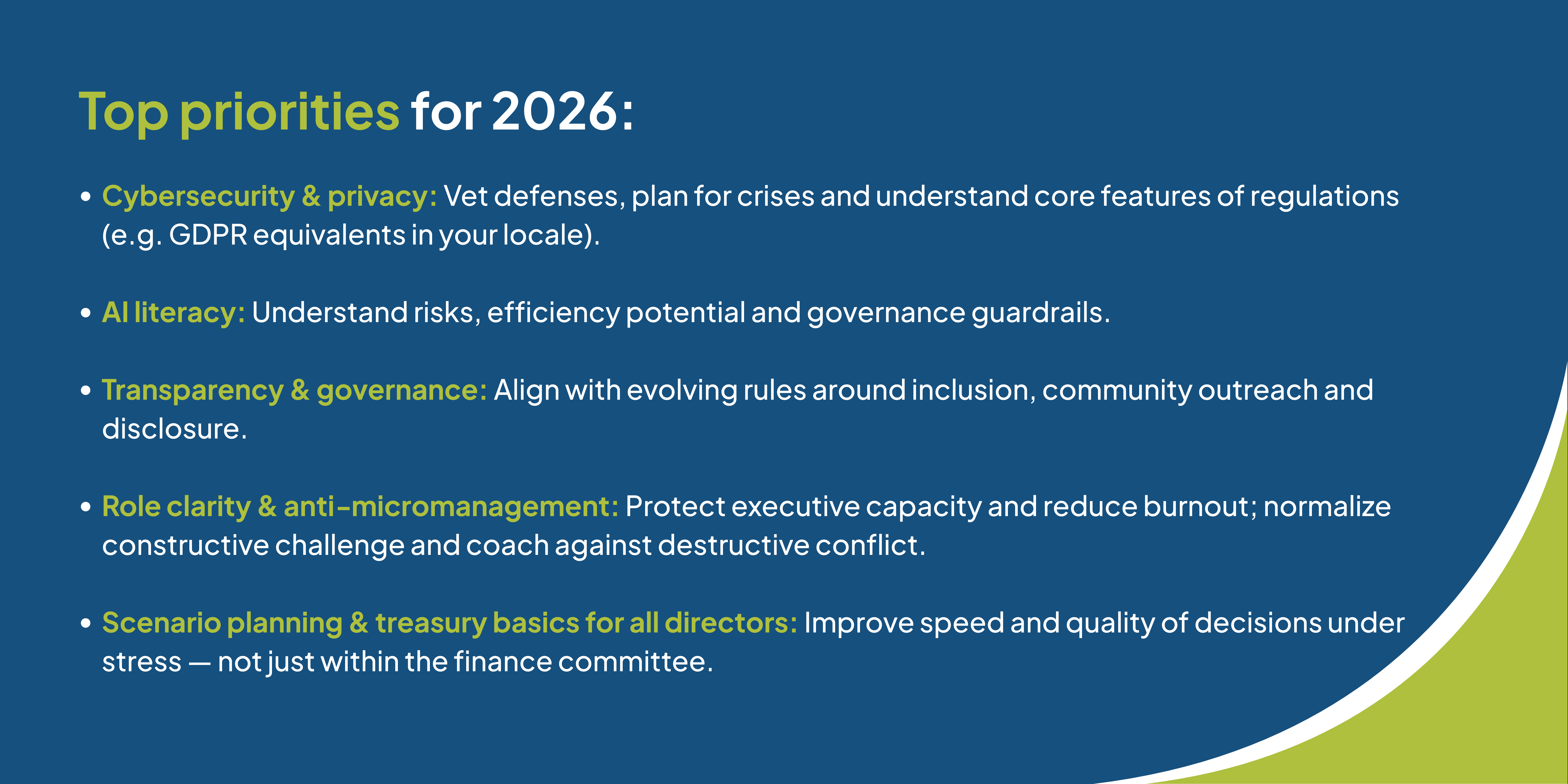
That pressure is showing up in boardrooms worldwide. As Diarmaid O Corrbui, CEO of Carmichael, notes: “We are in an era of greater uncertainty and geopolitical tension and there is a growing need for boards to explore scenario planning. As more nonprofits face funding and other challenges, tension in the boardroom is increasing. [Boards must] engage in constructive challenge with their colleagues and with executive.”
Cheretta Clerkley, AVP Governance Content Creation at BoardSource, adds a cautionary note: “The danger of micromanagement with boards and CEOs: when board members blur the lines between governance and management, they inadvertently sabotage the organization leading to staff burnout and turnover.”
Find your differentiator for the new year
While there are no easy answers when it comes to setting strategic priorities, there are surefire ways to help your team meet them. In a year defined by uncertainty, resilient nonprofits will plan for disruption, protect liquidity and adopt AI responsibly — with clear guardrails and measurable gains.
BoardEffect equips directors to do that work with speed and confidence — board training via searchable libraries and specialized workrooms, personal feeds and reminders for members, surveys and polls to track progress and gather feedback and more. GovernAI brings secure, fit‑for‑purpose AI to the boardroom so teams can stay focused on mission.
Fortune, as the saying goes, favors the prepared. Reach out today to request a demo to see how BoardEffect can help your board be better prepared for the months to come.
Ellen Glasgow serves as General Manager, Mission Driven Organizations for Diligent Corporation, the leader in modern governance providing SaaS solutions across governance, risk, compliance, audit and ESG. In her role, Ellen oversees the commercial team, which includes new and expansion sales, marketing, and sales development for the Diligent Governance solutions that support Mission Driven Organizations (Nonprofits, Associations, Education, Community Healthcare & Government).
NEXT POST :
What volunteer boards need to know about AISHARE THIS POST